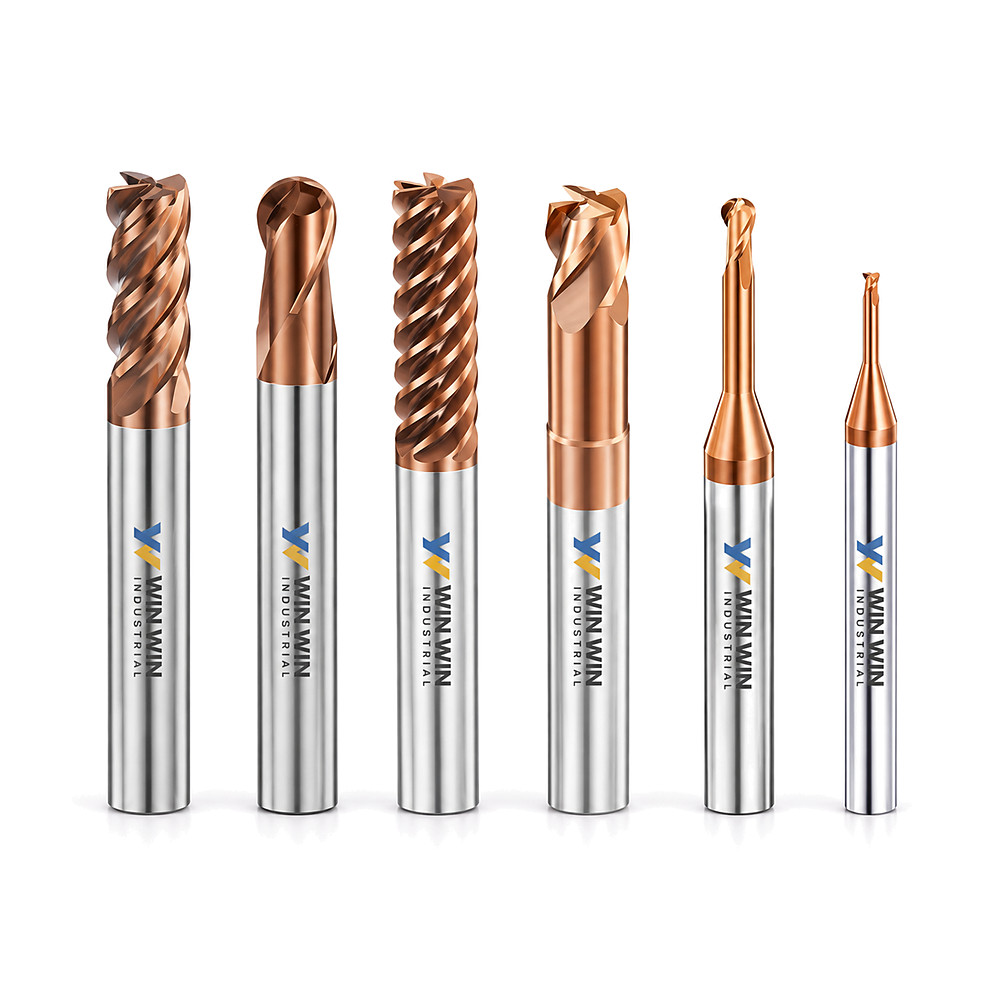
What hardness can this end mill actually handle?
It's built around 60HRC and above — that's the design target. In practice, customers also run it on quenched and tempered steel around 45HRC and on S136, DC53 and similar grades up to about 65HRC. Stainless up to 35HRC works too. If your workpiece is softer than that, you're probably paying for hardness you don't need — a general-purpose cutter may be the better cost call.
Which materials should I keep this tool away from?
Cast iron, aluminum alloy, titanium alloy, copper alloy, graphite and resin are not the target here. The coating and flute geometry are optimized for hard steel, so running aluminum or graphite will give you poor chip evacuation and short tool life. Pick a series matched to those materials instead.
What's the story with the PST coating?
Copper-brown PST, Hv 3600 surface hardness, film thickness 1.5–2.5 μm, friction coefficient μ 0.25–0.35, and it starts vaporizing around 1200℃. The Si element is what gives it abrasion resistance in hardened steel. Practically: less heat at the cutting edge, slower wear, and you're not changing tools as often.
Can I really use one tool for both roughing and finishing?
Yes — that's the point of the high-rigidity body and chip flute design. You can rough out a pocket and come back for the finish pass without pulling the tool. That said, if your finish tolerance is tight, a dedicated finishing pass with a fresh edge still gives you the best surface. The LH just means you don't have to stop and re-tool between operations.
What sizes are available?
Square end: φ1–20mm, standard and long, 26 specs. Corner radius: φ3–16mm, standard and long, 21 specs. Ball nose: R1.5–R10mm, standard and long, 37 specs. If you're running deep cavities, the long types are worth a look — they save you from ordering custom lengths.
How do I make sure I'm ordering the right spec?
Send us your workpiece material and hardness, depth of cut, spindle speed and machine type. We'll confirm the recommended model, coating option and delivery schedule. If you're between two specs, tell us the application — that's usually enough to pick the right one.